
Professional liming of orchards and vineyards

Balanced soil nutrition
Calcium (Ca), magnesium (Mg) and sulphur (S) supply
Improving soil structure
Optimal water-air regime and better rainfall absorption.
Increasing plant defences
Better resistance to fungal diseases and physiological disorders.
Promoting the healthy growth of vines and fruit trees
Creating optimal soil conditions
Liming of orchards and vineyards
Nutritional value of liming
Liming is essential to ensure sufficient supply of essential nutrients needed for healthy growth and development of fruit trees and vines. By liming, we supply the soil with three key elements: calcium (Ca²⁺), magnesium (Mg²⁺) and sulphur (SO₄²-). These nutrients are essential for proper plant metabolism, cell wall formation and photosynthesis.
For example, vines need approximately 150-200 kg of calcium (CaO) and 80-120 kg of sulphur per hectare. For orchards, the nutritional needs are similar, with calcium and magnesium being key to producing quality fruit. Calcium is particularly important for root growth and overall biomass. Its deficiency can lead to damage to young leaves, restricted growth and reduced crop quality.
To maintain optimum soil health, it is essential to monitor the cation exchange capacity (CEC), which measures the soil’s ability to bind important cations. For heavy clay soils, it is recommended to maintain calcium saturation at 80 %, magnesium at a maximum of 10 % and acidity (H⁺) up to 5 %. For medium-heavy soils, calcium saturation should be 70-75 %, magnesium 10-12 % and acidity up to 10 %.

Resistance to fungal diseases and physiological disorders
Calcium plays a key role in the natural defences of plants. It is essential for the formation of cell walls and membranes that protect plants from pathogens and pests. A sufficient supply of calcium increases the resistance of plants to fungal diseases such as powdery mildew or powdery mildew, while reducing the incidence of physiological disorders such as chlorosis or fruit rot.
Research shows that limed vineyards have significantly less powdery mildew infestation and a lower incidence of chlorosis. This positive effect is also seen on alkaline soils, where liming maintains optimum plant health. For example, research by Dr Gaspar Vanek has confirmed that regular liming increases the overall vigour of the vines and reduces the need for chemical treatments.
Soil structure and water-air regime
One of the most important benefits of liming is the improvement of soil structure, which has a direct impact on the water-air regime. A stable soil structure allows better absorption and retention of rainfall during dry periods. This effect is particularly important for heavier, clay-rich soils that are prone to compaction.
Liming promotes the formation of stable soil aggregates through the process of flocculation. Calcium as a divalent cation (Ca²⁺) binds clay particles (with a negative charge) into ‘house of cards’ like structures. These structures form sufficient macro-pores to improve water infiltration and storage in the soil profile.
This mechanism is key to moisture management, as it allows the soil to capture rainfall during the winter and spring months and then use it during the drier growing seasons. Without sufficient liming, the soil would lose its retention capacity, leading to an increased risk of drought and reduced yields.
The implementation of liming
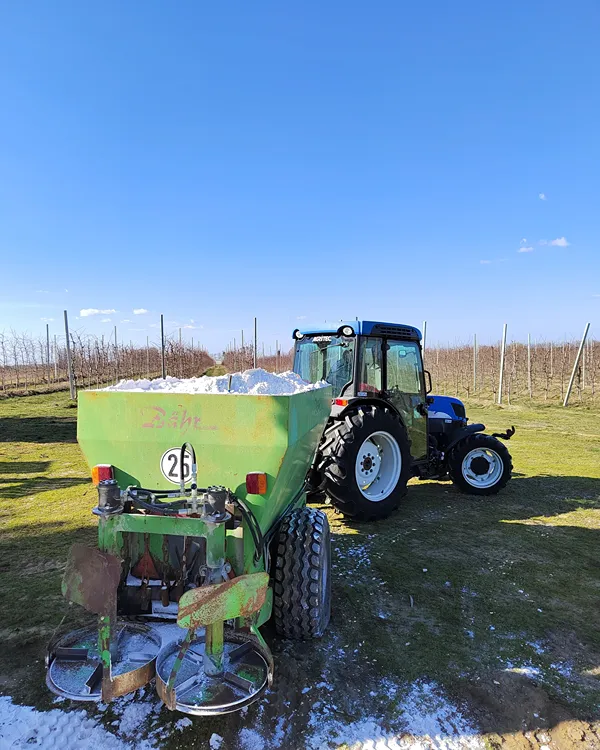
Successful liming depends on the selection of the right material and its reactivity. Finely ground limestone (0.07 mm fraction) will decompose in the soil in about a month, while coarser fractions can take years. It is therefore important to select a material with the optimum fineness to ensure the greatest possible contact area with the soil.
On neutral and alkaline soils, the application of gypsum (CaSO₄) is recommended, which quickly releases calcium while supplying sulphur. Gypsum is also suitable because it does not alter the pH of the soil and its effect is quicker than with calcareous materials.
When selecting the material, it is important to take into account its reactivity, which depends on the mineral composition and the fineness of grinding. For example, the 0,07 mm fraction has a reactivity of approximately 100 %, whereas the 0,25 mm fraction has a reactivity of only 30-40 %. It is therefore economically more advantageous to use finely ground materials, which provide higher efficiency at lower cost.
Liming is an essential measure for maintaining the health and productivity of orchards and vineyards. Lime treatment, when carried out correctly, improves the nutritional value of the soil, stabilises its structure and increases the plants’ resistance to disease. An investment in quality liming material will pay off in the long run in the form of higher yields and healthier crops.
Go to the article.